DVD Reviews: Three from Gary Cooper released on blu ray by Kino Lorber

Three of actor Gary Cooper's strongest films from his 1930s Paramount output have been released to blu ray and DVD by Kino Lorber's classics division. Cooper had a real strength of character in his performances, and later allowed his character roles to adapt as the man aged. Young, vibrant, and in his 30s, Cooper's work in these films features him at the height of his powers. Each of the three films will be reviewed separately.
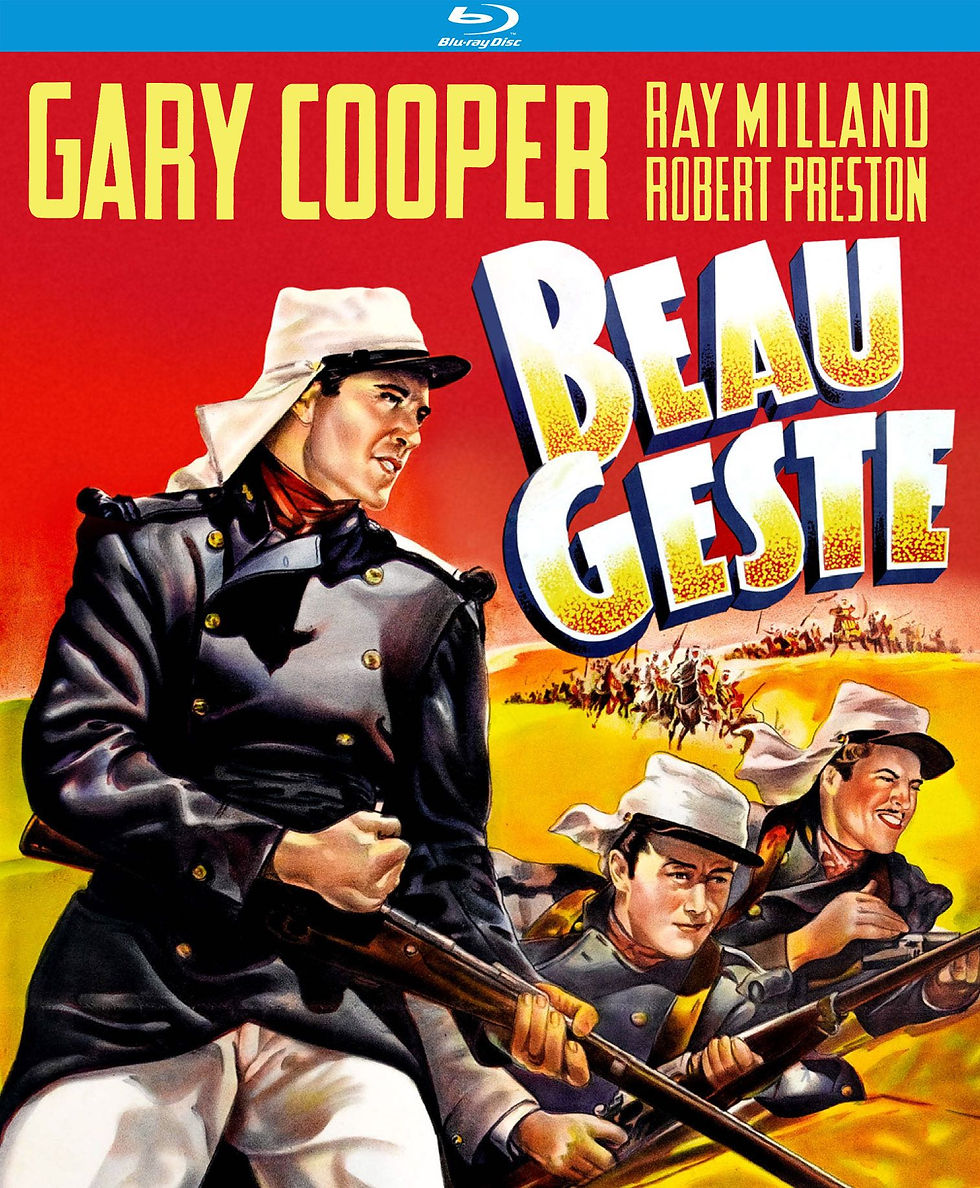
Beau Geste (1939)
Directed by William Wellman. Starring Gary Cooper, Ray Milland, Robert Preston, Brian Donlevy, Susan Hayward, J. Carrol Naish, Albert Dekker, Broderick Crawford. Released August 2, 1939. Running time: 112 minutes.
William Wellman's "Beau Geste" has been called a scene-for-scene remake of the 1926 silent, but, on its own merit, it holds up brilliantly.
The essence of the story is in regard to the exploits of the Geste brothers, played by Gary Cooper, Ray Milland, and Robert Preston, when they run off to join the foreign legion after one of them steals a valuable sapphire. While Milland and Preston are fine actors, it is really Cooper's movie, and his role that anchors every scene. His conflict is with Sergeant Markoff (Brian Donlevy), a brutally sadistic commander. Donlevy's performance netted him his only Oscar nomination.
Director Wellman's succession of shots is one of the most impressive things about "Beau Geste." Wellman deftly cuts from long shot, to medium shot, to close-up in an almost rhythmic manner, while still making sure to hold his shots long enough to allow the actors to display nuance. Early in the film, the shots of the dead legionnaires propped up over the fort's parapets continues to eerily resonate throughout. It is visually unsettling and brilliantly presented, immediately commanding the attention of the viewer.
The film's cast is dotted with welcome and familiar character actors further enhancing each scene. Albert Dekker is especially impressive as a mutinous Legionnaire.
Kino Lorber's blu ray is typically great, and enhanced by fascinating commentary from William Wellman Jr, the director's son, and Wellman biographer Frank Thompson.
The blu ray is available at this link: BEAU GESTE.

The General Died at Dawn (1936)
Directed by Lewis Milestone. Cast: Gary Cooper, Madeline Carroll, Akim Tamiroff, Dudley Digges, Porter Hall, William Frawley, Phillip Ahn, Leonid Kinskey. Released September 2, 1936. Running time: 98 minutes.
Lewis Milestone directs from Clifford Odets' script, with Gary Cooper cast as O'Hara, based on the exploits of adventurer Morris Abraham "Two-Gun" Cohen. Set in occupied China, O'Hara and his beautiful accomplice Judy Perrie (Madeline Carroll) attempt to get needed weapons to the authorities and keep them from the evil war lords. Akim Tamiroff was Oscar nominated for his portrayal of the sadistic General Yang. There are elements of the production that match the director's last name, with makeup artist Charles Gemora using prosthetics to alter the appearance of some actors, as well as the innovative shot of a doorknob evolving into a cueball as the camera pans back to reveal a billiards game in progress.
Lewis Milestone's best work shows him as a true craftsman, while Gary Cooper is at his sturdiest and most heroic and Madeline Carroll at her most beautiful and effortlessly compelling in her co-starring role. Clifford Odets' script was based on a novel that had not yet been published. It is colorful and exciting. It was his first screenplay, having previously only written for the theater.
It is fun to see William Frawley looking not too different from his iconic TV role of Fred Mertz despite being 15 years younger. Phillip Ahn, who specialized in Asian villains well into the television era (e.g. TV's "MASH") is well-cast here, while Dudley Digges is barely recognizable under Gemora's incredible makeup.
Kino Lorber's blu ray features commentary by writer and film historian Lee Gambin, whose commentary work is among the very best being offered on home video. He is joined by actress Rutanya Alda.
The blu ray is available at this link: THE GENERAL DIED AT DAWN.
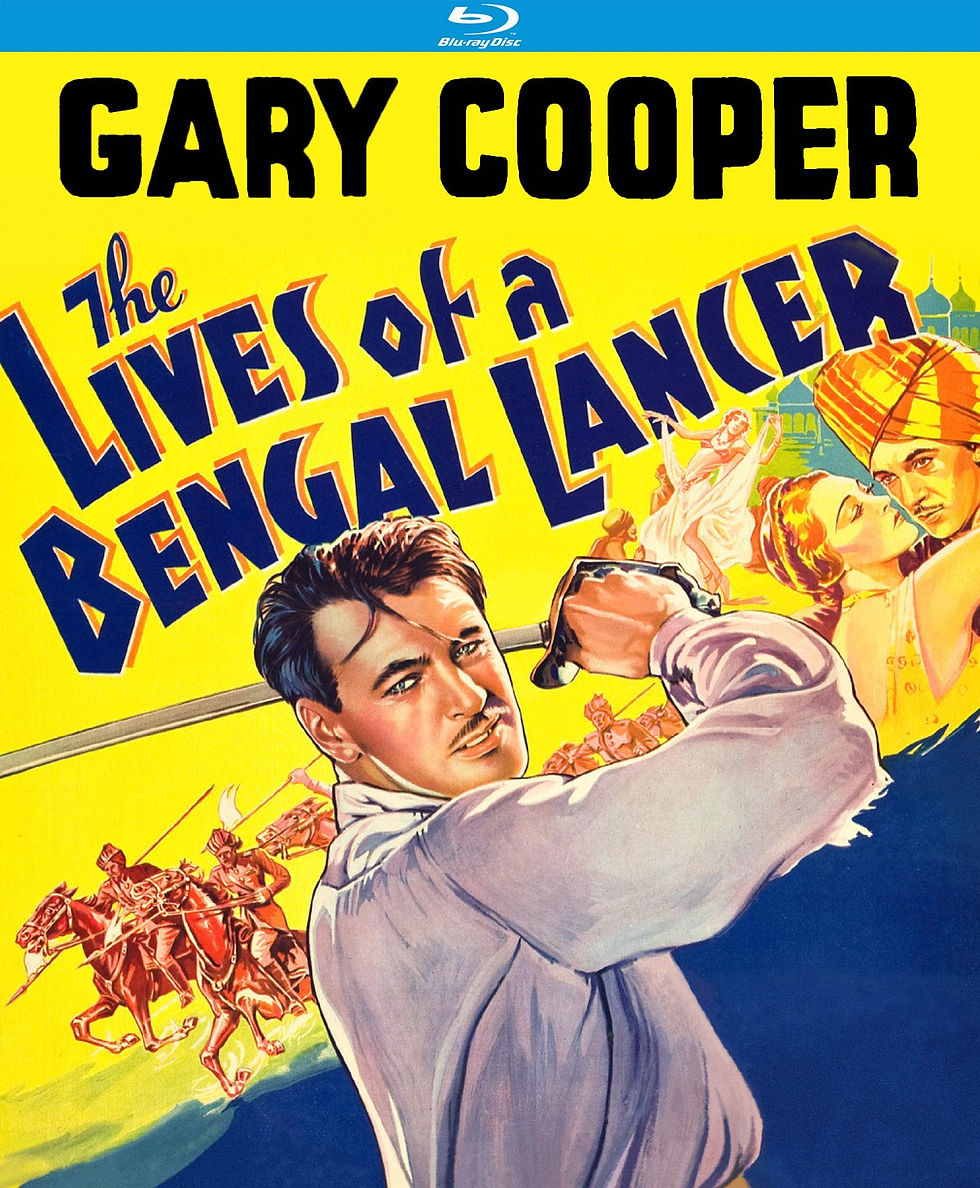
The Lives of a Bengal Lancer (1935)
Directed by Henry Hathaway. Cast: Gary Cooper, Franchot Tone, Guy Standing, Richard Cromwell. Released January 11, 1935. Running time: 109 minutes.
One of the great action adventure films of the 1930s, this screen version of Francis Yeats-Brown's 1930 book went through as many as a half dozen scenarists before being filmed by Henry Hathaway.
The movie is sort of an ensemble piece led by Gary Cooper as Lieutenant McGregor who is stationed in India with soldiers Forsythe (Franchot Tone) and Stone (Richard Cromwell). McGregor and Forsythe go after Stone when he is captured by the evil Mohammad Khan (Douglas Dumbrille). Stone's father is the garrison's commander (Guy Standing), who refuses to send in troops to rescue his son, believing it to be a trap. McGregor and Forsythe are captured by Khan during their attempt, and the three men are tortured until Stone talks, telling them where ammunition is to be delivered. The ammunition is stolen and taken to Khan, but the lancers then come to battle and rescue the three officers.
Each of the performances are first rate, with Cooper exhibiting heroism, Franchot Tone as haughty but committed, and Cromwell as exuberant but immature. Douglas Dumbrille is a character actor whose prowess in both comedy and drama was equally impressive. It is in this film in which he has the dialog, "we have ways of making you talk," which has become something of a catchphrase.
The film was a major box office hit, and holds up very well as late as the 21st century. Kino Lorber's blu ray features an excellent audio commentary by film historian and scholar Eddy Von Mueller.
The blu ray is available here: LIVES OF A BENGAL LANCER
Each of these three classic films has something to offer. Along with Gary Cooper as the star, a ll three movies feature top direction by the finest filmmakers in cinema's rich history, and supporting casts with some of the best actors. True examples as to why the 1930s was an exceptional decade of motion pictures, each of these films is most highly recommended.
Comments