DVD Review: Harry Langdon at the Hal Roach Studios 1929-1930
Updated: Sep 24, 2020

Harry Langdon is one of the great comedians and filmmakers of the silent era, exploring areas of edgy surrealism that challenged screen comedy's conventions.
He was less successful during the sound era, which has resulted in his talkies being somewhat less accessible to fans, collectors and historians.
Kit Parker Films, through Sprocket Vault, has released all eight of Langdon's early sound short comedies for the Hal Roach studios. Each of the films in this set will be discussed separately:
Disc One: The 1929 shorts

HOTTER THAN HOT
Beautiful restored picture elements but sans its missing soundtrack, "Hotter Than Hot" is presented as an ersatz silent with appropriate music composed and performed by Andrew Earle Simpson. Because it is such of an early talkie, it doesn't rely as much on dialog, and does more with visuals, so it plays effectively as a silent, with its dialog presented via subtitles. Having the opportunity to finally see Harry Langdon's first Roach talkie in any form is important to our better understanding of his transition to sound films. Langdon's manner, his tentative reactions, and his slow blinking stares, are all here, further enhanced by Thelma Todd as his leading lady, and appearances by Edgar Kennedy and Frank Austin. While reading the dialog is less effective, Harry's stammering lines like, "And besides I don't know you - I don't know you from Adam, and I don't know Adam - pretty good" give us some idea of how he added dialog to his established screen character. Things even get a bit suggestive with the line "are we going to make boom-boom?" Perhaps the most amusing, and equally risqué, physical business is when Harry tries to get a key away from unconscious Thelma Todd, but it is down the front of her dress. While it likely plays better with its soundtrack, "Hotter Than Hot" still comes off as an amusing sound debut for Mr. Langdon.
SKY BOY
The other film in this set with nicely restored picture elements but missing its soundtrack (and again presented with music composed and performed by Andrew Earle Simpson). This one opens with Thelma Todd and Eddie Dunn crashing an airplane onto an iceberg and being stuck there. Eddie is ready to take advantage of Ms. Todd when they discover that Harry is stowed away on board and is stranded with them. Of course the comic idea of Harry being Thelma's protector is funny in and of itself, but the film presents some great sight gags. Again, we are at a disadvantage having to read Harry's dialog as subtitles rather than hear his stammering comic delivery, but "Sky Boy" still comes off as a very amusing subject even when limited to its visuals. There's a funny ice fishing sequence, and another where Harry attempts to give Eddie a shave. The blimp rescue ends the film with a good laugh.

SKIRT SHY
The earliest Langdon two-reeler where we have the dialog track to enjoy, "Skirt Shy" is both fascinating and delightful. We can now hear how Harry Langdon uses dialog as another layer to his established screen character. Just as his visuals were slow, pondering, and tentative, so is his use of dialog. Just as in his silents, Langdon allowed his character to stop, think, and decide his next action, in this talkie he has the same approach verbally. He'll essentially think out loud, stammering through his words until he arrives upon a decision. However, in order to appreciate this approach, one must be able to fully tap into Harry Langdon's surreal concept for comedy. Even some of the most learned comedy film historians have trouble connecting with Langdon's approach to sound films, especially his season with Roach. But in "Skirt Shy" we see Harry donning women's clothing, like he had in his silent "The Sea Squawk" and being pursued by a nearsighted old man and an imposing rustic westerner, both of whom mistake him for a lady they're interested in. It's a silly farce, but consistently funny, with some remarkable visual gags. Harry's battle with boxing gloves tied to a vine is particularly outrageous. Harry trapped in a greenhouse with hive of angry bees is another highlight. In these Roach films, Harry is exploring how he can retain the integrity of his established comic persona while working in the sound film medium. "Skirt Shy" is the earliest film where we can see, and hear, that process taking place.
DISC TWO: The 1930 Shorts:
THE HEAD GUY
Probably better known than the other Langdon-Roach comedies, due to its long ago appearance on some VHS shorts collections, "The Head Guy" also has a pretty notorious reputation. Often people react to this film as something of a train wreck, with Harry bumbling confusedly through the proceedings. An especially notorious scene where Harry sobs while eating a sandwich includes the oft-quoted line "I won't eat my apple now, I'll eat my apple after now." However, "The Head Guy" is really a perfect example of how necessary it is to tap into Langdon's very offbeat approach to comedy. When viewed from this more open-minded perspective, a film like "The Head Guy" is bizarrely funny. There really is a method to the madness, per se. While I have learned to better appreciate this short, it is decidedly not for all tastes.
THE FIGHTING PARSON
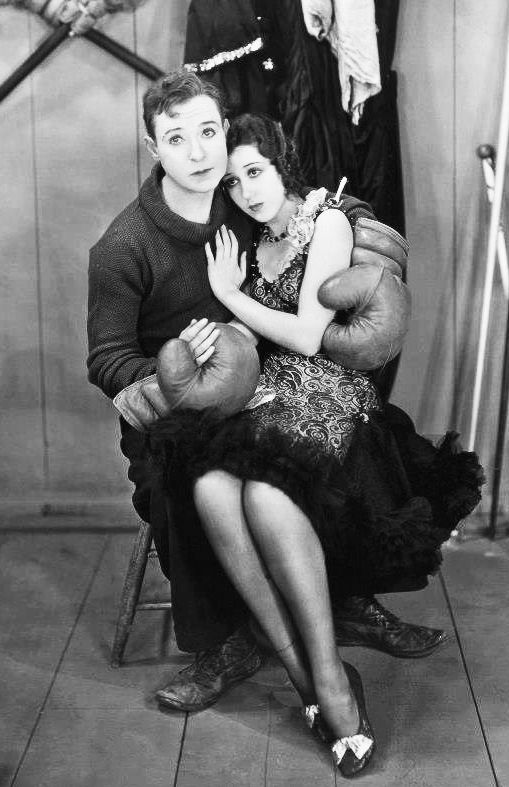
An improvement over his previous Roach films, this one's premise has meek Harry, a traveling entertainer, mistaken for the title character, a man who is noted for turning lawless towns into lawful ones. We are reminded of his silent classic "The Strong Man" when instead of the expected Rock of Ages, Harry performs a banjo ditty and a tap dance. In a boxing challenge, Harry fights with two extended prop arms flailing about from his sleeves. Fast-paced and funny, "The Fighting Parson" shows some real growth in Langdon's sound films, as Harry becomes more comfortable with dialog situations as they augmented his visual presentation.
THE BIG KICK
At this point the Harry Langdon comedies are really progressing in a positive manner, as this one further improves upon "The Fighting Parson." Mostly visual in its execution, which is a plus, "The Big Kick" features Harry and pretty Nancy Dover being held hostage by bootleggers. Harry had long established his frightened little boy reactions to dangerous situations, but with this talkie, he adds the stammering verbal delivery as further enhancement to the character. A balloon gag resurrected from Langdon's silent short "His New Mama," shows that Harry was exploring what he could do with some of his past work in the new sound medium, and given at least some input beyond his performance.
THE SHRIMP
While the premise of a picked upon weakling turning the tables on his attackers is pretty standard, it comfortably fits the character Harry Langdon has perfected. Harry is shown as being the butt of cruel jokes by the other tenants at his boarding house, but after being injected with an experimental serum that gives him courage, he starts bullying the bullies. "The Shrimp" is a bit faster paced than Langdon's previous Roach efforts, as his films continue to show improvement and Harry starts to really take command of doing comedy in sound films.

THE KING
What turned out to be Harry's final film for Roach is another amusing effort where he plays the title character with Thelma Todd as his queen. We are reminded of his silents "Saturday Afternoon" and "The Chaser," when Harry plays a henpecked husband who is supposed to be a ruler, but is himself ruled by his shrewish wife. One of the highlights has Harry about to be spanked like a child by the queen, so he sticks a horseshoe in the seat of his pants to shield him from the pain. By now Harry has become discernibly more comfortable doing sound films, and was settling into a solid comic niche as he had in silents. Making his transition with these films, he would continue to hone his methods over the next many years.
After this film, Harry left the Hal Roach studios. The films were successful with critics and audiences (Film Daily said of "The Shrimp": "Harry Langdon is right up to snuff with a bushelful of laughs in two reels."). But Harry had a shot at doing a feature for Warner Brothers and wanted to take that opportunity. Plus, he was not particularly happy. Having been his own producer and his own director, Langdon was used to having a bit more creative control over his work. His contract did not allow him the creative freedom Roach allowed Stan Laurel or Charley Chase. Often his suggestions were heeded but he was chagrined when they were not.
Langdon would continue to make amusing, popular sound shorts for Paramount (all of which are lost), Educational, and Columbia, as well as appearances in a few features, until his death in 1944 at the age of 60. As he journeyed through sound comedies, he never quite recaptured the magnificence of his timeless silents, but there were many highlights throughout the remainder of his career at each of the studios where he starred in two-reelers.
This Langdon-Roach DVD further benefits from some great extras, including Langdon's fascinating audition reel for Hal Roach, where we are allowed to see him first attempt working with sound in films. The alternate Spanish version of "The Big Kick" (entitled, "La estracion la gasolina") is a rare and intriguing look at how a lot of comedies were re-filmed in different languages for different countries. While it is historically important, the footage of the Hal Roach studios being dismantled and its contents auctioned off is truly heartbreaking to see. And each short in the set features an alternate audio commentary track by comedy film historian Richard M. Roberts.
Harry Langdon is one of screen comedy's true greats, and yes it is mostly because of his work in silents. However, a comedian of this magnitude should have all of his work available and accessible. Harry did not make his best films at the Hal Roach studios, but they are much better than their reputation, and Kit Parker should be commended for putting these historically significant films on DVD. There are a lot of reasons to own this DVD set.
The Langdon-Roach set can be purchased at this link: HARRY LANGDON/HAL ROACH
Comments