Book Review: New book on Character Actor Edward Everett Horton
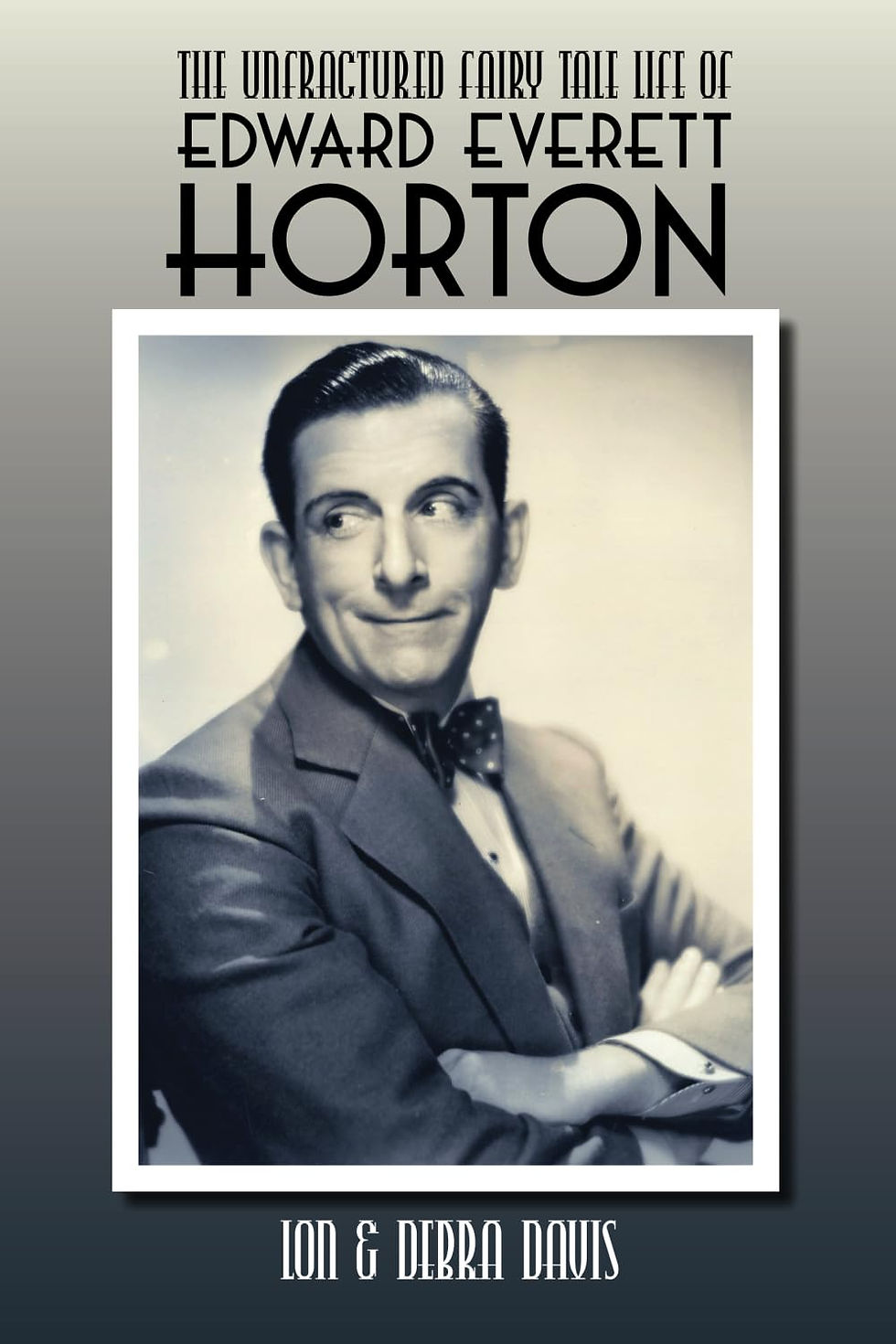
Those of us from the 1950s and 1960s were likely introduced to Edward Everett Horton via his voice, narrating Jay Ward's Fractured Fairy Tales cartoons for television. Many of us later discovered that Mr. Horton had an extensive motion picture career as a character actor. Lon and Debra Davis's new book for BearManor Media, appropriately titled The Unfractured Fairy Tale Life of Edward Everett Horton, is an extensive look at the man and his work.
This fascinating study carries us through Horton's early life, allowing us to see a lot of what inspired the actor's approach to his many roles. It is quite interesting to read how Horton started out being hired as a stage manager with the promise of acting when needed, and how he played a many bit parts as he could to gain experience. His delight in exploring the nation by going on the road in different productions, his gradual growth into larger roles, his becoming more noticed -- all of this is told by the authors in detail.
This reviewer especially enjoyed reading about Horton's early films, including Vitagraph silents and some indie-produced sound short comedies at the dawn of the talkies era. This is what eventually led to Horton's very notable appearances in films like Top Hat, Design for Scandal, and Arsenic and Old Lace. Some parts are larger, some are quite small, but even if he had just one line in the entire production, his few moments resonated throughout the film. He had a striking comic presence, enhanced by his great voice.
That voice made him a star for a generation on television. Narrating Jay Ward's accurately identified Fractured Fairy Tales, Horton's calm elegance belied the subject's craziness. For instance, when Snow White and Rose Red became, in Ward's hands, Slow White and Nose Red, Horton's seriousness as a narrator added to the outrageous absurdity.
Horton kept working to the very end, appearing in such 60s films as Stanley Kramer's It's a Mad Mad Mad Mad World, Norman Lear's Cold Turkey, even the barely released R-rated indie 200 Years Later, which Horton had a great time making.
Edward Everett Horton died at 84 in 1970.
Lon and Debra Davis have garnered a reputation for top biographers and their latest is one of their best. The Unfractured Fairy Tale Life of Edward Everett Horton is highly recommended for libraries, research centers, and fans. It is available for order at this link: HORTON
Comments